World Masters Squash Championships 2028: Johannesburg Hosts for a Third Time
The day after the finals in Perth, World Squash announced the next host. The World Masters Squash Championships 2028 will be played in Johannesburg, South Africa. It is the fourth time the country has hosted the event and the third time for Johannesburg, after 1997 and 2016. The organisers have since launched an official site, wsmc2028.com, which says entries will open in 2027.

Image: World Squash Masters Championships 2028 organising committee, wsmc2028.com
The Masters is the largest individual championship in squash by entries. Perth 2026 brought more than 900 players from 55 nations together for 1,639 matches across 21 age categories. Amsterdam 2024 passed 1,000 entries. Johannesburg will be aiming for the same scale, at altitude, in a city with one of the deepest masters squash communities anywhere.
This guide collects what has been announced, what has not, and what players and organisers can do now.
Key Facts
| Detail | Info |
|---|---|
| Event | World Masters Squash Championships 2028 |
| Dates | Not yet announced (recent editions: August to October; the official site points to September and October) |
| Location | Johannesburg, Gauteng, South Africa |
| Venues | Parkview Squash Centre, The Country Club Johannesburg, The Wanderers Club |
| Organiser | World Squash Federation (WSF) with Squash South Africa |
| Headline sponsor | Assore Mining |
| Age categories | Over 35 to Over 80, Open and Recreational; may extend to Over 85 for men depending on entries |
| Entry | Opens in 2027 according to the official site; requires a World Squash SPIN |
| Accommodation | Centred on Rosebank, with tournament transport to the venues |
| Official site | wsmc2028.com |
| Previous South African editions | Johannesburg 1997, Cape Town 2006, Johannesburg 2016 |
Venues
Three clubs in Johannesburg’s northern suburbs will share the draw. The official site says they sit within about 6 km of each other, with tournament transport planned between designated hotels and the venues.
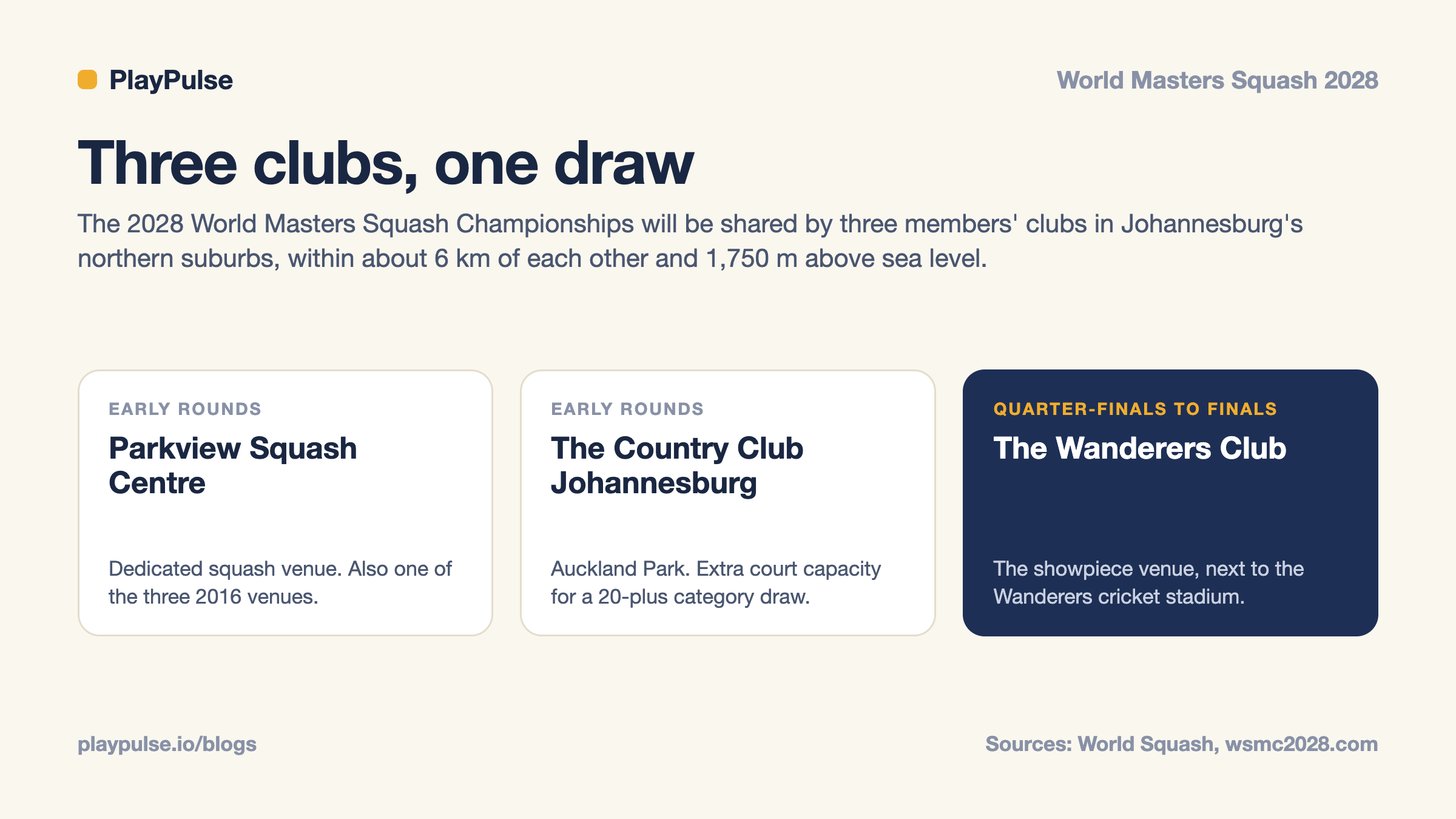
Parkview Squash Centre A dedicated squash venue and one of the three venues in 2016. Expect it to carry a large share of the early rounds.
The Country Club Johannesburg, Auckland Park One of the oldest sporting clubs in the country. Its squash courts add the parallel capacity a 20-plus category draw needs in the first three days.
The Wanderers Club The showpiece. Wanderers will host the quarter-finals, semi-finals and finals. In 2016 the younger age groups played here, and the club is best known internationally for the cricket stadium next door.
Splitting a Masters across venues is normal. Perth used three, Amsterdam used several. The difference in Johannesburg is that the three clubs are established members’ clubs rather than public centres, so expect bars, restaurants and viewing galleries that were built for spectators.
Where to stay. Tournament accommodation will be centred on Rosebank, a short drive from all three clubs, with hotels, restaurants and a Gautrain station for the airport and Pretoria. Staying there keeps you on the tournament transport routes.
What Has Not Been Announced
Two things players will want to know are still open:
- Dates. World Squash has not published them. The 2016 Johannesburg edition finished on 30 September, Perth ran 30 August to 6 September, and Amsterdam was in August. The official site describes September and October as the months to explore South Africa, which fits the pattern, but nothing is confirmed. Plan for the second half of 2028 and wait for the confirmed week before booking anything non-refundable.
- Entry window and fees. The official site says entries will open in 2027. Perth’s registration opened around a year out and closed on 19 July 2026, six weeks before play, with an entry fee of roughly AUD 115. Expect a similar rhythm.
The official site has a sign-up form for announcements. We will update this post as the details land.
Age Categories
The Masters uses five-year age bands, with separate men’s and women’s draws in each. The reference date for 2028 will be set by the organisers, but the bands are stable:
| Category | Age requirement |
|---|---|
| Over 35 | Born 1993 or earlier |
| Over 40 | Born 1988 or earlier |
| Over 45 | Born 1983 or earlier |
| Over 50 | Born 1978 or earlier |
| Over 55 | Born 1973 or earlier |
| Over 60 | Born 1968 or earlier |
| Over 65 | Born 1963 or earlier |
| Over 70 | Born 1958 or earlier |
| Over 75 | Born 1953 or earlier |
| Over 80 | Born 1948 or earlier |
The birth years above assume you turn the qualifying age during 2028. Check the official entry conditions when they are published, because the organisers may tie the reference date to the event dates.
Each band is split into two competition levels:
- Open: for players who have competed in national championships or open-level events.
- Recreational: for players who have competed at club or social level only.
The organisers have said that, depending on entries, the men’s draw may extend to Over 85 and the women’s to Over 80. Doubles and Squash 57 social events are planned alongside the main draws, so players knocked out early still have matches to play. Squash 57 is the larger-ball version of the game, formerly called racketball.
The recreational level is what makes the Masters more than a veterans’ elite event. A club player can enter a world championship and play people of a similar standard, in a draw that guarantees more than one match.
How Entry Will Work
The process has been the same for several editions and there is no reason to expect a change:
- Get a SPIN (Squash Personal Identification Number) from World Squash if you do not already have one. It is free and takes minutes.
- Register on the official event site, wsmc2028.com, once entries open, which the organisers say will be in 2027.
- Choose your age category and level, singles and doubles where offered.
- Pay the entry fee.
Enter early. Masters draws are capped by court time, and late entries in the popular bands (Over 45 to Over 60) are the ones that get squeezed.
South Africa and the Masters
South Africa’s masters community is one of the strongest in the sport, and it shows in the record.
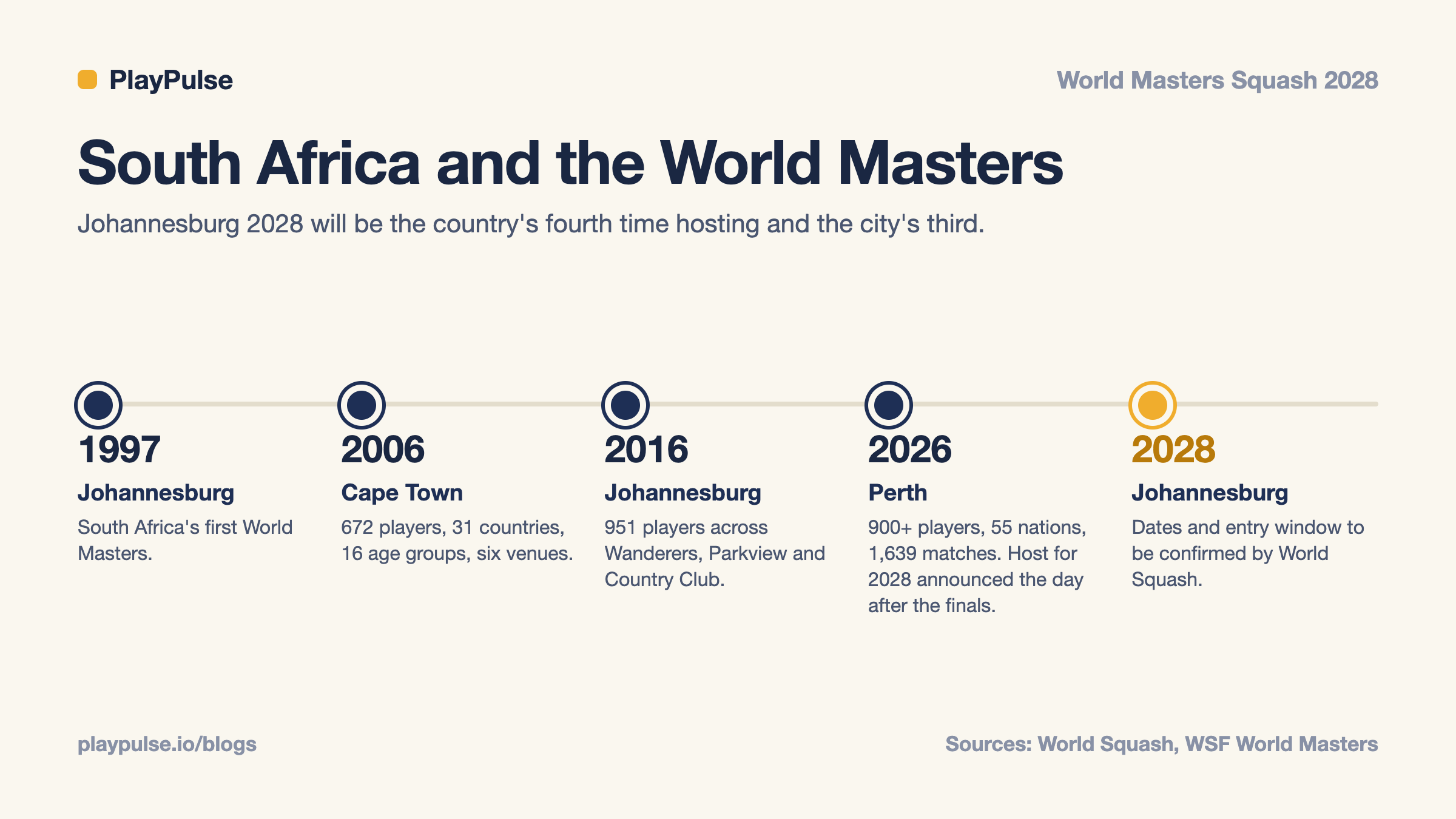
- 1997, Johannesburg. South Africa’s first World Masters. World Squash President Zena Wooldridge said in the 2028 announcement that it was her own first World Masters.
- 2006, Cape Town. 672 players from 31 countries across 16 age groups, played over six venues from Kelvin Grove to the University of Cape Town.
- 2016, Johannesburg. 951 competitors. Craig van der Wath won the Men’s Over 50 for the third year running and took a record sixth World Masters title. England won six categories; the hosts won three.
- 2026, Perth. Stan Voges won the Men’s Over 70 for South Africa on finals day.
Squash South Africa general manager Jennifer Sawyer credited the sponsor, Assore Mining, for making the bid possible, and pitched the country as “world-class sport, unforgettable experiences and exceptional value”. The value point is real: for European and Asian players the rand makes a week in Johannesburg noticeably cheaper than Perth or Amsterdam.
Playing at Altitude
Johannesburg sits at about 1,750 metres above sea level. It is the one thing about this edition that every visiting player should plan around.
- The ball is livelier. Thinner air means less drag. Drops sit up, lobs carry further, and the game is faster than at the coast. Local players grow up with it; visitors need a few sessions to recalibrate their length.
- You tire sooner. Reduced oxygen shows up in long rallies and in the third match of the day. Most visiting teams arrive four to seven days early. If you can, play practice matches at the venues rather than just hitting.
- Hydrate more than usual. Highveld air is dry, especially before the summer rains arrive in October.
None of this is a reason to skip the event. It is a reason to arrive early and to treat the first two days as acclimatisation rather than peak form.
The Logistics Challenge
A Masters is a scheduling problem before it is a squash tournament. Perth ran 1,639 matches in eight days across three venues. Johannesburg will do similar numbers across three clubs that also have members wanting their courts.
What organisers have to get right:
- Draws across 20-plus categories at once, each with a consolation or plate so first-round losers keep playing.
- Court allocation per venue per day, with the finals funnelling into Wanderers.
- Results reaching players within minutes, because a player whose next match depends on a result at a different club needs to know when to leave.
- A single public draw and schedule that works on a phone, since almost nobody carries a laptop between venues.
Perth’s experience is worth reading for anyone helping to run 2028. Players did not just consult the official draw. They organised themselves around it, in club groups and country groups, and built their own daily schedules. Our write-up of Courtside, the companion app used by a quarter of the Perth field, is a case study in what players actually want from event software.
For Players: How to Prepare
- Sort your SPIN now. It is the one prerequisite you can complete today.
- Sign up for updates on wsmc2028.com, and watch World Squash news and Squash South Africa, which will carry the dates and the entry link first.
- Book refundable travel once dates are announced, and give yourself the extra days for altitude.
- Play the ratings-tracked events in your area. Seedings draw on international results, and a year of tracked matches gives the seeding committee something to work with.
- Enter both singles and doubles if doubles is offered. It doubles your court time for a small increase in cost.
For Organisers: Lessons from the Masters
The Masters is the extreme case of the problem every multi-category event faces. The lessons scale down to a 100-player club open:
- One source of truth for the draw, published online and updated live.
- Results entered at the court, not collected on paper and typed in at night.
- A plan for the consolation draws, which generate as many matches as the main draws and are where most players spend their week.
- A communication channel that reaches every player, not just the ones who check email.
PlayPulse handles registration, multi-category draws, scheduling and live scoring for events from club level up. If you are involved in an age-group championship and want to see how it runs, get in touch at info@playpulse.io.
Frequently Asked Questions
Where is the World Masters Squash Championships 2028?
Johannesburg, South Africa. World Squash announced on 7 September 2026 that South Africa will host the Championships for the fourth time. Matches will be played at Parkview Squash Centre, The Country Club Johannesburg in Auckland Park, and The Wanderers Club, which hosts the quarter-finals, semi-finals and finals.
When is the World Masters Squash 2028 and when does entry open?
Dates have not been announced yet. The official site, wsmc2028.com, says entries will open in 2027. Recent editions have run between August and October. Watch wsmc2028.com, worldsquash.sport and Squash South Africa for the confirmed schedule.
Who can enter the World Masters Squash Championships?
Any player aged 35 or over on the age reference date, in five-year bands from Over 35 to Over 80, each with an Open and a Recreational level. Depending on entries, the men’s draw may extend to Over 85. You need a SPIN (Squash Personal Identification Number) from World Squash.
Has South Africa hosted the World Masters before?
Yes, three times: Johannesburg in 1997, Cape Town in 2006 and Johannesburg again in 2016, when 951 players competed and Craig van der Wath won a record sixth World Masters title in front of a home crowd.
Does altitude affect squash in Johannesburg?
Yes. Johannesburg sits at roughly 1,750 metres. The thinner air makes the ball livelier and rallies faster, and visitors from sea level tire sooner in the first few days. Arriving early to acclimatise is the standard advice.
Related Reading
- World Masters Squash Championships 2026: Everything You Need to Know
- Courtside: How a Free App Reached a Quarter of the World Squash Masters Field
- World Masters Games 2027 Kansai: Squash in Kyoto
- Squash at the 2028 Olympics: What You Need to Know
- How to Run a Squash Tournament: A Complete Guide
Planning a squash tournament of your own? PlayPulse handles registration, draws, scheduling, live scoring, and ratings for events of any size. Get started or reach out at info@playpulse.io