Courtside: How a Free App Reached a Quarter of the World Squash Masters Field
On the Thursday of the World Squash Masters 2026 in Perth, a player I had never met walked up to me between matches and asked if I was “the app guy”.
I was. I had built the app for my own clubmates. By the end of that week, a quarter of the 911-player field was using it, and nobody had announced it. This post is written for the people who run a sport: the chief executive who reports to a board, the events team that runs the schedule, and the board itself. It covers what players did with a tool nobody marketed to them, what that tells you about your own members, and what a federation would know at the end of its next event if the tool were official.
The problem was never the draw
A world championship brings hundreds of players in from sixty-odd countries. Most are travelling. Many come alone or with two or three clubmates. And the whole thing still runs on a desktop draw website and WhatsApp groups with 200 unread messages.
The draw site tells you your own match. It does not tell you that your mate from Brisbane is on court 4 at the same time, that the doubles pair you met at dinner both won this morning, or who is free at 4pm to watch the glass court. You piece that together by scrolling, screenshotting and asking.
I was competing in the M40 and I wanted one page that answered “what is happening for my people today”. So I built it.
Courtside reads the official draw, lets each player claim their profile, and drops them into groups: their country, their age division, and any custom group they create. Each group gets a daily playcard: everyone you know, when and where they play, results as they land, shared to WhatsApp in one tap. The playcard is styled like a paper printout so it looks intentional when it gets screenshotted into a chat.
The launch that wasn’t
There was no launch. I sent the link to a few friends. No poster, no email from the event, no federation channel, no ads. I made it free and let it spread or die on its own.
I wanted to know what players would do with a tool when nobody was marketing it to them. For a federation that is the useful part: the numbers below are member behaviour with no promotion behind it, so they are a floor, not a ceiling.
It spread. Player to player, club group to club group. A few days in, people who had never met were organising dinner in it.
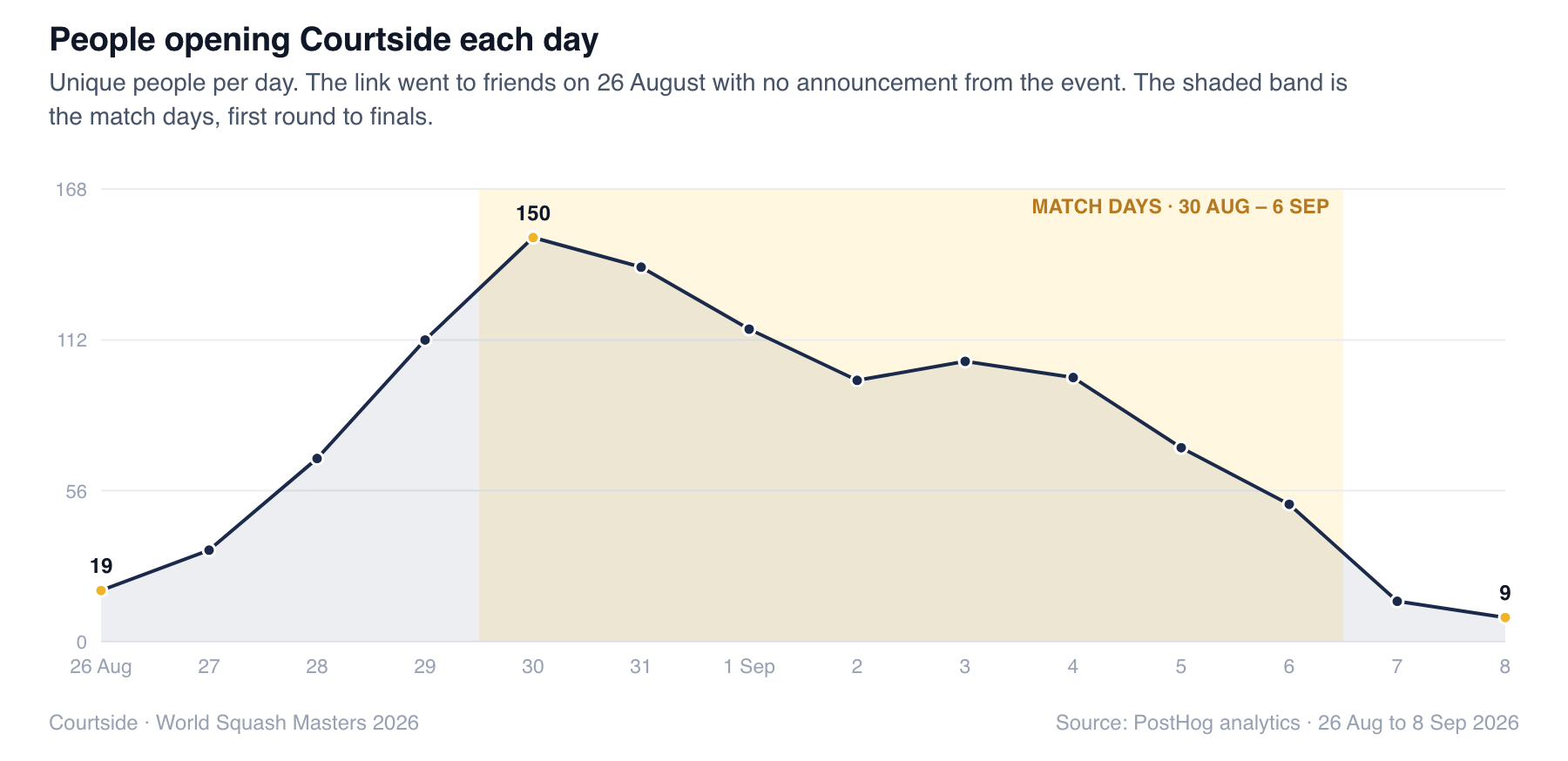
Nineteen people opened it the day I shared the link. The busiest day, 30 August, had 150. The curve follows the tournament exactly: it climbs through the early rounds, holds through the middle of the week, and falls away as players are knocked out and fly home. Within days of the finals it was back to single digits, which is the right shape for a tool with one job.
By the time the event was over, 392 people from 19 countries had used it. In the first week alone, 227 of the 911 players in the draw had claimed their profile. Unless a figure says otherwise, the numbers in this post cover the whole event.
What people actually used it for
At this event, live scores were never the gap. The organisers had a live-scoring link and every player knew where it was. What nobody had was a way to find each other’s matches. Not every championship starts from there. At an event run on a membership platform, results are scattered across venues, paper sheets and separate pages, and there Courtside pulls them into one place as well as the people. But the reason it spread in Perth was the second thing.
That is what people came for. Who is playing now, who won, who is free for lunch, whether anyone needs a doubles partner. The screen that kept people coming back was the group playcard, and the results feed took 3% of all views.
Two figures surprised me more than the headline adoption.
Thirty-seven groups, created by thirty-three different people. I built the auto-groups by country and division. Players built the rest themselves, one club at a time, without being asked. One club’s playcard was opened 566 times in twelve days by 16 people. That is three visits per person per day, every day, for the length of the event.
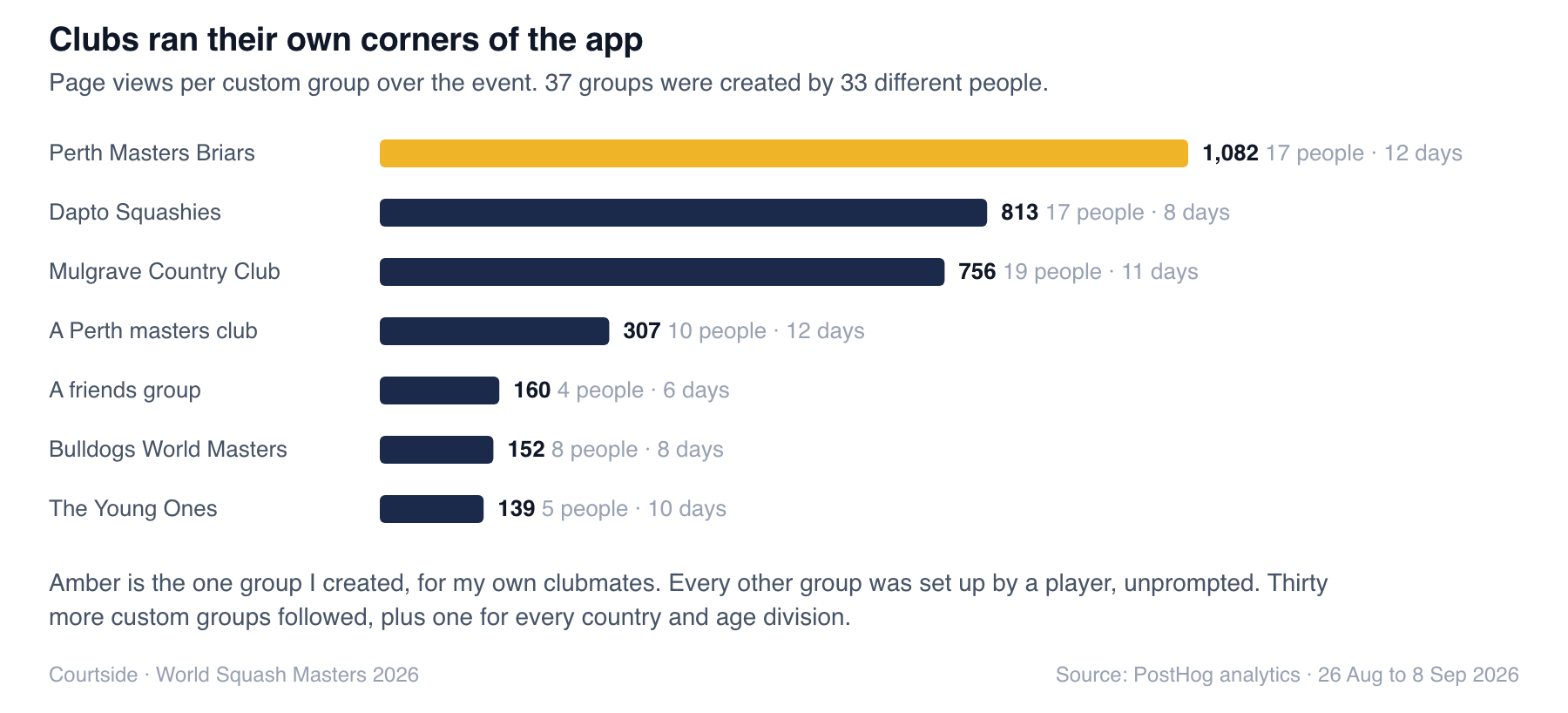
The group I made for my own clubmates was the busiest, but not by much, and I had nothing to do with the next two. Dapto Squashies and Mulgrave Country Club each set one up, shared it around, and ran their own corner of the app for the rest of the event. Every club that turned up with a handful of players did the same thing with the same tool.
Two in three visits arrived direct. Not from a link in a chat, not from a search. People saved it to their home screen and opened it like an app.
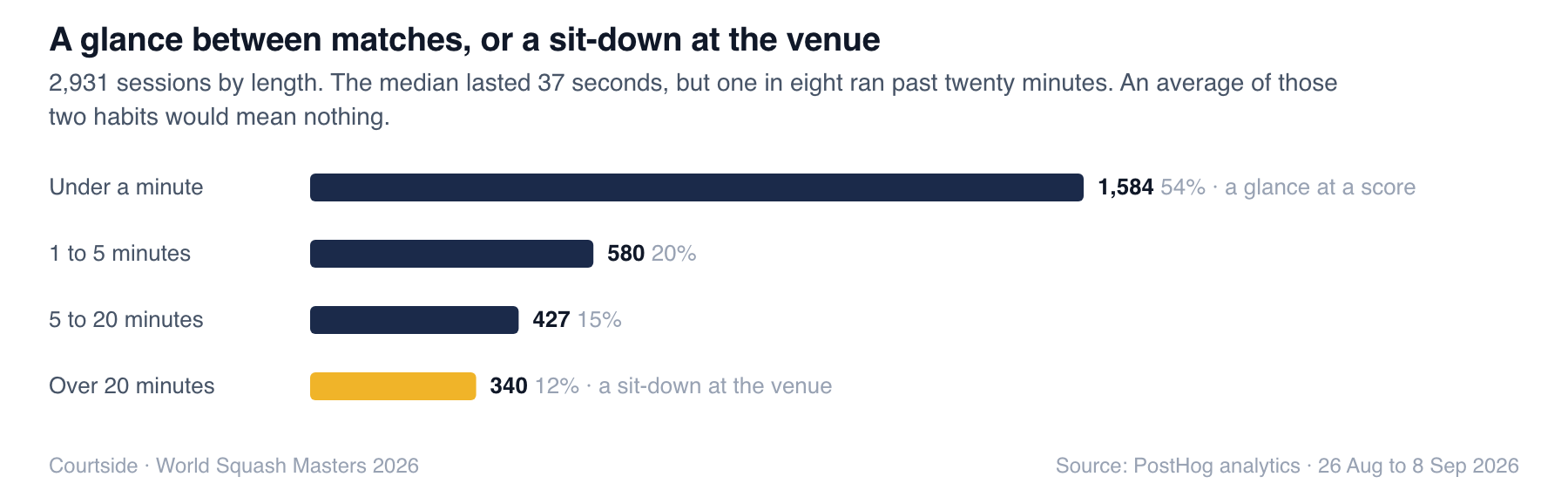
Visits were either a glance or a sit-down. Across the whole event there were 2,931 sessions. The median lasted 37 seconds, and more than half were under a minute: a check of a score between matches. But one in eight ran past twenty minutes, which is someone at the venue with the playcard open, watching results land. An average of those two habits would be meaningless, so I am not quoting one.
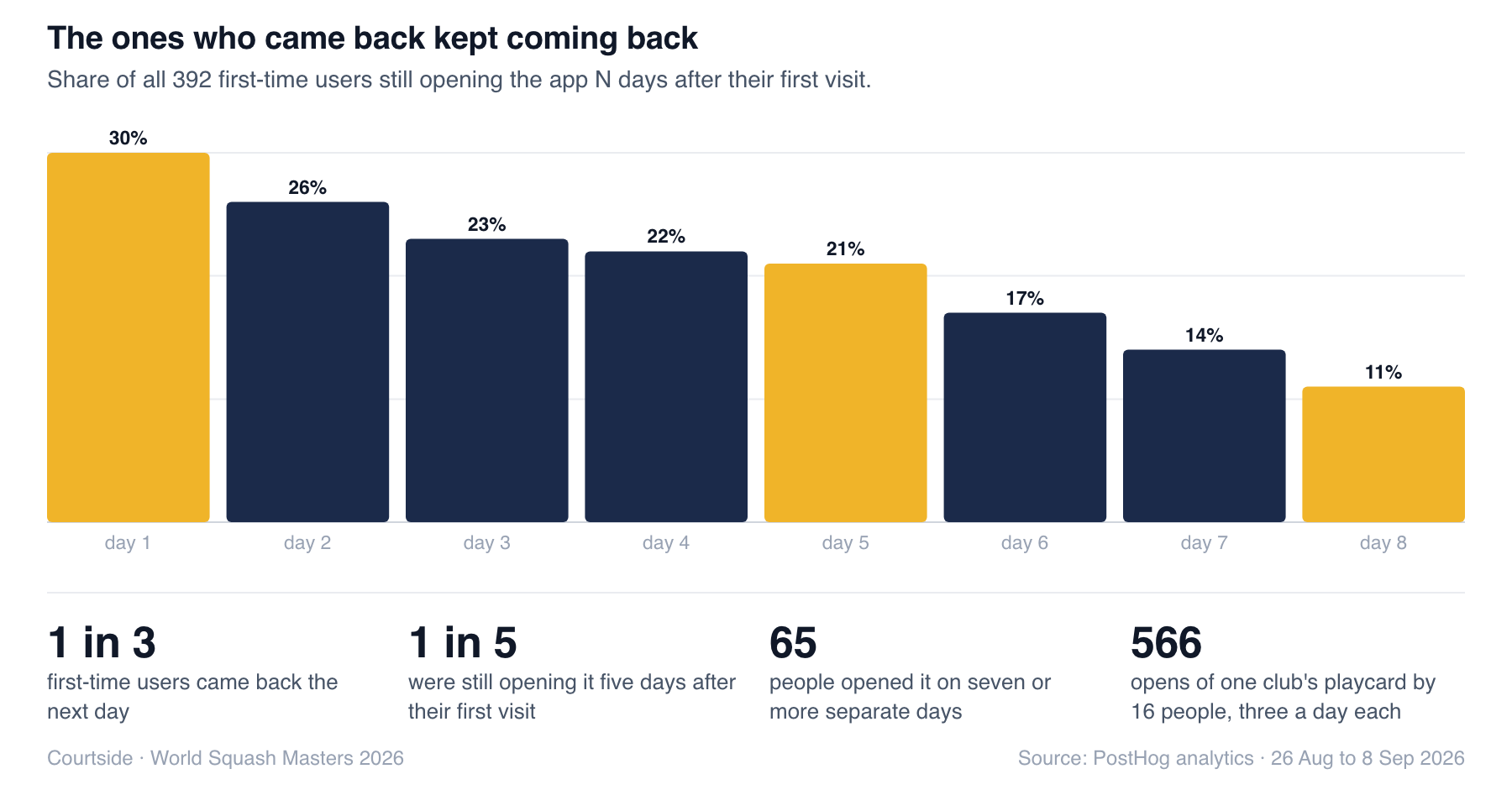
Retention followed the same pattern. About a third of first-time users came back the next day, and one in five were still opening it five days after their first visit. For a tool that only exists for one week, in a field where most people are over fifty, that is the kind of engagement federations write strategies about. At a junior championship the people following would be parents and coaches, and the curve would likely be steeper.
The event on one board
Everything below is straight from the analytics, laid out the way a board or an events team would read it. Click the board to open it full size.
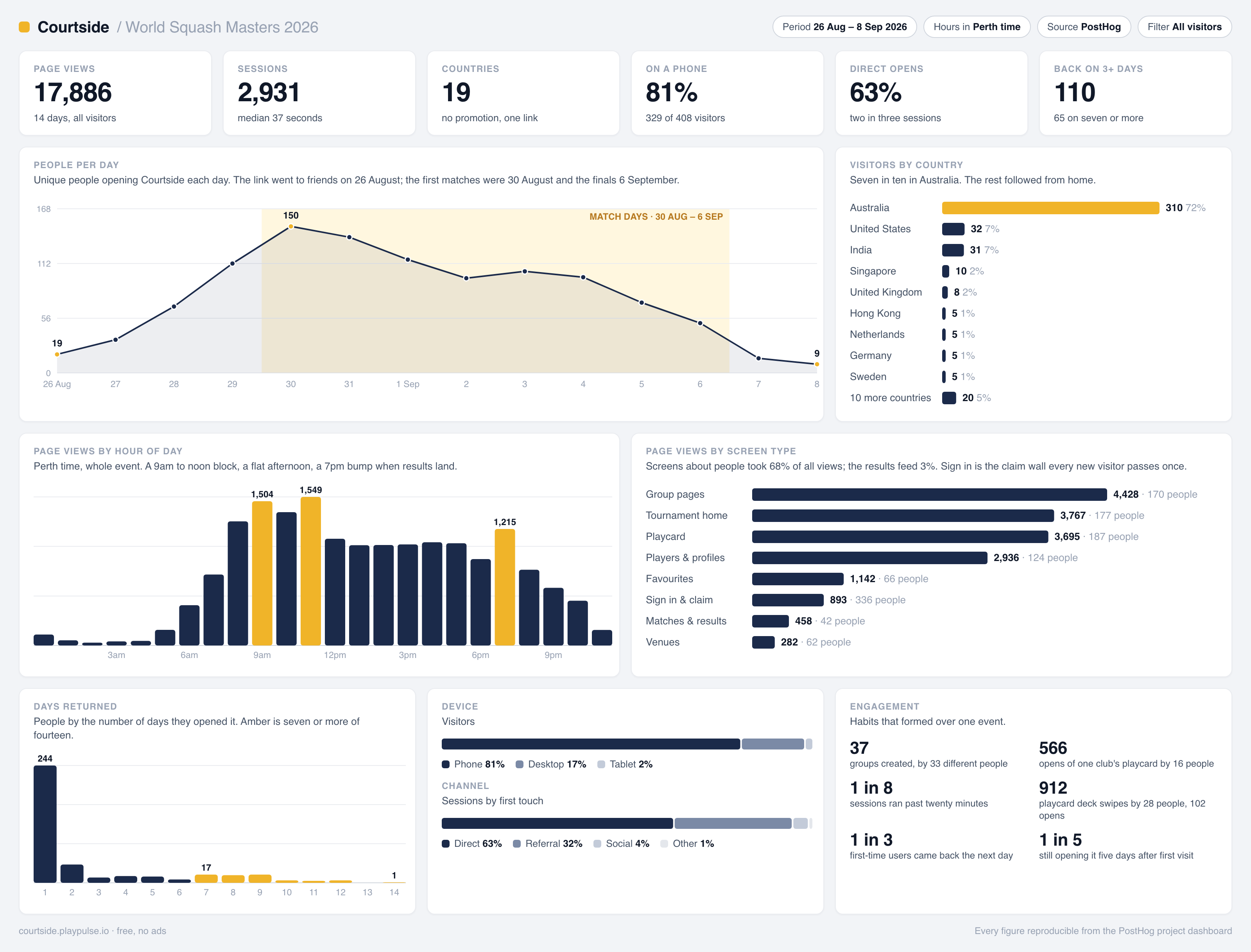
For a federation, three tiles matter. Seven in ten visitors were in Australia and the other 18 countries were following from home: India produced 469 page views from 31 people who were never in Perth. Four in five visitors were on a phone and two in three sessions opened direct from the home screen, which is how people treat an app, not a website. And 110 people came back on three or more days, 65 of them on seven or more.
For whoever runs the schedule, the other tiles. Screens about people (groups, the playcard, profiles, favourites) took 68% of all views and the results feed took 3%. Attention ran from 9am to noon, held through the afternoon and bumped again at 7pm when results landed and the next day’s playcard went out. A schedule change published at 8am reaches most of the field before their first match. One published at 3pm competes with the courts.
What this says to a federation
None of this went through an event or federation channel, so the numbers show what members do when nobody is marketing to them. They organise themselves, if the tool is useful and the friction is low enough. Thirty-three of them built club groups without being asked, and clubs that arrived with a handful of players ran their own corner of the app for the whole event.
The point for a federation is not “build an app”. It is what members do when a tool answers the question they actually have: they organise themselves, they share it, and they come back every day of the event. That is the behaviour worth designing for, and Courtside shows what it looks like on a real draw.
Read the numbers as a map of what players care about, in order:
- Their people. The group playcard, not the results feed, was the screen that brought people back. Players want to know who is on court, who won and who is free, for the handful of people they came with.
- Right now. More than half the visits were under a minute and two in three came straight from the home screen: a check between matches. Anything that takes more than one tap to answer “where is my match” loses to WhatsApp.
- The venue day. The peak, 150 people on 30 August, came mid-draw while most of the field was still in, and the twenty-minute sessions were people at the venue with the playcard open. That is where the attention is, and where a court change, a sponsor message or a canteen special actually lands.
For the next event, that tells you where to put the effort. Seed a group for every club before day one rather than waiting for a captain to do it. Make court status and schedule changes the first thing on the screen. And make the playcard the thing people share, because they will share something either way.
I am happy to walk any federation or event team through the data, the mistakes and the setup. Nothing is for sale.
What changes when it is the official platform
Everything above happened with a link passed hand to hand. A quarter of the field turned up with no help from the event. The event itself has channels I never had: the entry confirmation email, the draw page, the venue screens, the players’ briefing. Put the link there and the players who never heard of it join the ones who did.
With the whole field on it, an organiser gets things a WhatsApp group cannot give:
- A complete picture of the audience. Every claimed player, their country and club, and the family and coaches following them. Reach for the board and for sponsors, measured rather than estimated.
- A channel to the right people at the right moment. A court change goes to the players on that court and the people following them, not to 900 inboxes at once.
- A record of how the event actually ran. Which courts ran late, where the congestion was, which day peaked. Next year’s schedule is built from that, not from memory.
- The pathway view over time. Who came back, who stopped, and at which age band. That is the retention signal a federation reports on and rarely has.
Put against the questions a chief executive and an events lead actually ask, this is where it stands:
| The question | After your next event |
|---|---|
| Who took part, by age band and country | Answered today, from the draw and claimed profiles |
| Who followed from home, and from where | Answered today |
| Which clubs travel together, and how big their groups are | Answered today |
| How attention moves through the day and across the week | Answered today |
| Which players had the largest following: family, coach, club | Needs follow history, a small addition |
| When a court ran late, and by how much | Needs a first-seen-live timestamp on matches |
| Shares, notification opens, check-ins | Needs the events added before the tournament |
| Whether players and families come back the following season | Needs a second event on the same platform |
The right-hand column is honest about the gaps. Each one is a small piece of work, and the reason to do it before an event rather than after is that the data only exists if it was being collected on the day.
If players are encouraged to share
The playcard is styled like a paper printout because I watched people screenshot the draw. Players shared it into club chats without being asked, and 37 groups grew from that. Make sharing a feature rather than a habit: a share button on every playcard and result, the event and sponsor mark on the card, a prompt after a win. Each share carries the event into chats and feeds it would never reach otherwise, and each one can be counted. For a sponsor that count is worth more than a banner at the venue. It is impressions among the people the sport most wants to reach: the players’ own families and clubs. For a board it is the start of the economic-impact story governments ask for, because every follower from another city or country is a traveller or the family of one.
Courtside is not a business
It is free, has no ads, and stays free. There is no licence to negotiate and no vendor to be locked into. What I wanted from it was conversations with the people who run the sport, and a world championship puts them all in one venue for a week.
One signal worth passing to a board: a few players found the donate link on my website and sent money without being asked. Members pay for what they value.
If I sit down with a governing body, I will not be pitching a hypothesis. Their members already use the product.
The one-page version for the board
- Reach you can put in front of a sponsor. 392 people from 19 countries, 2,931 sessions, 150 on the busiest day, from one event with no promotion. That is a measured audience, not a survey, and the official channels were never used.
- Engagement that holds for the whole event. A third of first-time users came back the next day, one in five were still opening it five days on, and 65 people used it on seven or more separate days.
- Player and family experience, answered at the source. “Where is my match, who won, who is free” stopped being WhatsApp traffic and became one page per club group, opened three times a day.
- Members organise themselves. Thirty-three people built their own club groups without being asked. Give members a page for their people and they run it for you.
- The next event can be measured properly. Participation, reach, attention and club structure are available today. Following, schedule drift and season-on-season return need small additions made before the event, not after.
Courtside came out of the same workshop as PlayPulse, which runs registration, draws, scheduling and live scoring for federations, clubs and event organisers. The two are different tools for different jobs, but they share a belief: the people in the draw are the point, and software should help them find each other.
The app is at courtside.playpulse.io. If you run a federation or a national event and want to see the analytics behind these numbers, or run it at your next championship, email info@playpulse.io.
Frequently Asked Questions
What is Courtside?
Courtside is a free companion app for large racquet events. It reads the official draw, lets players claim their profile, and builds a daily playcard for their group: who is on court when, who has won, and who is free. It was built for the World Squash Masters 2026 in Perth and lives at courtside.playpulse.io.
Is Courtside free?
Yes. Courtside is free, has no ads, and will stay free. There is no licence and no lock-in. It exists to be useful to players and to give federations and event teams evidence about their own members.
How many players used Courtside at the World Squash Masters 2026?
In the first week, 227 of the 911 players in the draw used it, with no announcement from the event and no advertising. By the end of the event, 392 people from 19 countries had used it. The busiest day saw 150 people on the app.
What would an event gain by making Courtside its official app?
A complete picture of who is at the event and who is following them, a channel to push court and schedule changes to the right players, and a record of congestion and peak days for planning the next edition. Shares, notification opens and check-ins are not measured yet and would be added before an event so the data exists at the end of it.
Can my federation use Courtside at its next championship?
Yes. Courtside imports tournaments from tournamentsoftware.com and has already run more than one event. If you run a national or international draw and want it at your next event, or want a walkthrough of the analytics behind this post, get in touch at info@playpulse.io.
Related Reading
- World Masters Squash Championships 2026: Everything You Need to Know
- World Masters Squash Championships 2028: Johannesburg Hosts for a Third Time
- How to Run a Squash Tournament: A Complete Guide
- How to Grow Your Squash Club
- Live Scoring for Squash Tournaments
Planning a squash tournament of your own? PlayPulse handles registration, draws, scheduling, live scoring, and ratings for events of any size. Get started or reach out at info@playpulse.io